
Dial 999 first. Always. Even if you are standing next to a defibrillator, even if someone has already fetched it, and even if the machine is already attached. A defibrillator treats the heart. It does not send an ambulance.
The 999 call handler will tell you where the nearest public access defibrillator is, and will send a Community First Responder if one is free.
What to do
- Dial 999 and ask for an ambulance.
- Start CPR if the person is not breathing normally. The call handler will talk you through it.
- Send someone else to fetch the nearest defibrillator. Stay with the patient yourself.
- Follow the machine’s spoken instructions. It will not deliver a shock unless a shock is needed.
Where the defibrillators are
The islands have one of the most comprehensive networks in Scotland. It covers all the major settlements and every school in Mull and Iona, and there are public access defibrillators in Erraid and in Ulva. The number grows as funding is secured and as businesses and building owners agree to host a machine.
Download the defibrillator map (JPG). You are welcome to use this map on your own website or in your own publications. The more people who know, the better.
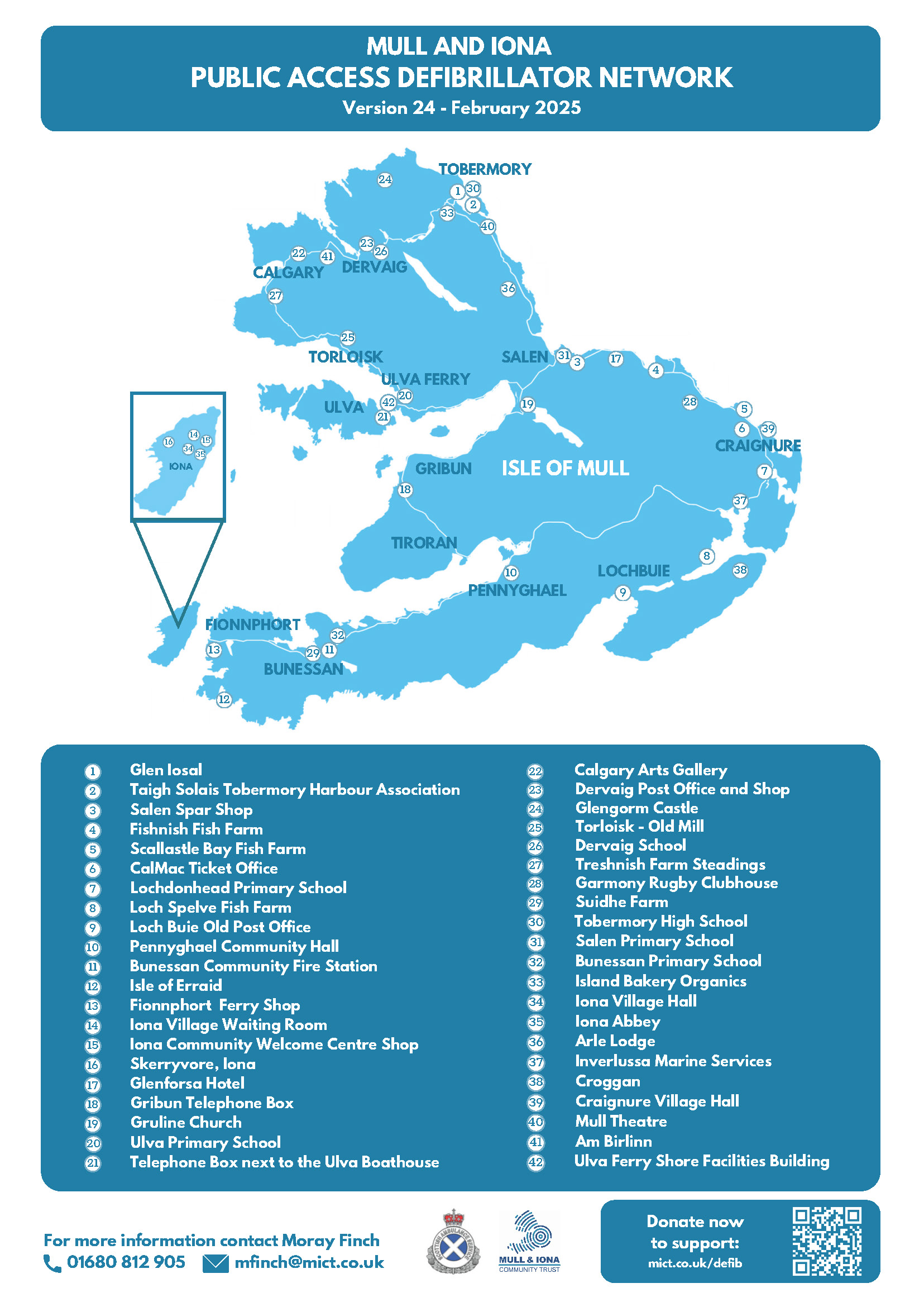
TO CONFIRM: There is no list of defibrillator locations anywhere on the old site. The only record is the downloadable JPG map, which cannot be read by a screen reader, searched, sorted, or used on a phone with a poor signal. Before this page can do its job, MICT needs to supply a machine-readable list: site name, settlement, a plain description of where the cabinet is, grid reference or latitude and longitude, whether access is 24 hours, and any cabinet code. Without that list, neither this page nor a map on the new site should claim to tell anyone where the nearest machine is.
TO CONFIRM: Every location must be verified against the Scottish Ambulance Service register before publication, not taken from the old page or the old map. The map file is dated 2025 and machines move, are retired or are added. Publishing a location that is wrong could send someone the wrong way during a cardiac arrest.
Who checks them
Local volunteer Guardians check the defibrillators every month. The checks are coordinated by MICT’s Facilities Manager, and an online report is completed each time to confirm to the Scottish Ambulance Service that every unit is working.
TO CONFIRM: No Facilities Manager appears on the current staff list. Confirm who coordinates the Guardian checks now, and whether facilities@mict.co.uk is still the right address.
Community First Responders
Five Community First Responder networks operate in the islands: Iona, the Ross of Mull, Dervaig, Ulva Ferry and Tobermory. They exist because residents volunteered to take the role on.
TO CONFIRM: Whether all five networks are currently active and staffed. This is a 2025-era statement and responder numbers change.
Training and volunteering
Defibrillator and CPR training is available, and the responder networks are always glad of new volunteers. To take up training, to become a Community First Responder, or to ask anything about the network, email facilities@mict.co.uk or phone 01680 812900.
Help with the running costs
The machines cost money to keep ready. Batteries are replaced every five years and the sticky pads every three. A small donation to the revenue fund is much appreciated. Donate here.
TO CONFIRM: Replace the old-site donate link with the new site’s donate page URL once it exists.